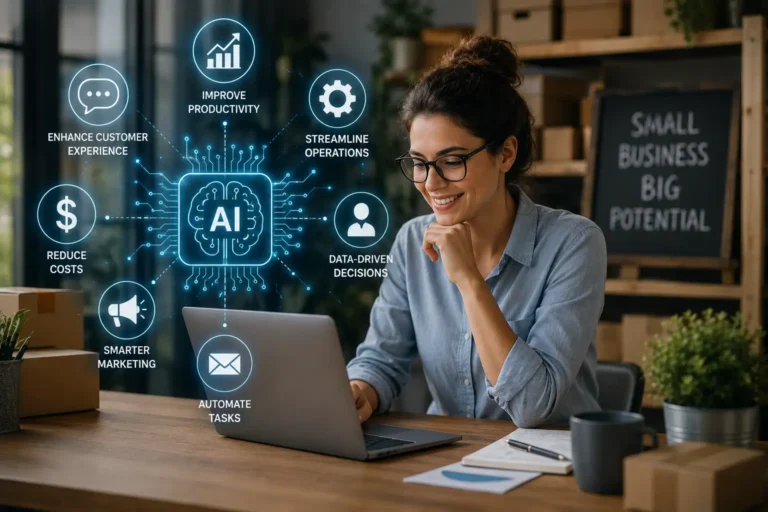
Artificial intelligence has rapidly moved from being something only large technology companies could afford to becoming an everyday business tool. Across the UK, businesses of every size are discovering practical ways to use AI to save time, reduce costs and improve customer experiences.
For many small business owners, the biggest challenge has never been a lack of ideas—it has been a lack of time. Managing enquiries, producing marketing content, analysing sales figures and keeping customers informed can consume hours every week.
Modern AI tools are helping to automate many of these repetitive tasks, allowing business owners to spend more time focusing on growth, customer relationships and strategic planning.
The important point is that AI is not replacing business owners. Instead, it is becoming another tool that supports better decision-making and increases productivity.
AI Is Improving Everyday Productivity
Many businesses now use AI to assist with writing emails, creating reports, analysing spreadsheets and generating marketing ideas.
Tasks that previously required several hours can often be completed in minutes, allowing staff to focus on work that genuinely requires human judgement and creativity.
Customer support has also improved dramatically. AI-powered chat assistants can answer common questions around the clock while passing more complex enquiries to human staff.
This creates faster response times without reducing service quality.
Companies that embrace new technology often discover similar efficiencies through smart home technology to improve efficiency, security and convenience, as automation becomes increasingly common in both business and personal life.
Marketing Is Becoming More Intelligent
Marketing has always relied on understanding customers.
AI now allows businesses to analyse customer behaviour far more effectively than before, identifying patterns that help improve advertising, website content and social media campaigns.
Rather than guessing what customers may want, businesses can make decisions using real data.
AI can also generate draft content, suggest headlines, analyse search trends and even recommend improvements to website performance.
However, successful marketing still requires human oversight. Authenticity, creativity and understanding customer needs remain essential.
Businesses that combine AI with experienced decision-making are generally achieving the strongest long-term results.
Better Decisions Through Better Data
One of AI’s greatest strengths is analysing large amounts of information quickly.
Sales reports, customer feedback, website analytics and financial data can all be reviewed far more efficiently, helping business owners identify opportunities that might otherwise be overlooked.
This doesn’t mean every recommendation should automatically be followed.
Instead, AI provides additional information that supports more informed business decisions.
Many growing companies are finding that combining technology with traditional business experience creates a significant competitive advantage.
Skills Will Continue to Evolve
As AI becomes increasingly common, the skills businesses value are also changing.
Creative thinking, communication, leadership and problem-solving remain difficult to automate, making them even more valuable in the modern workplace.
Employees who understand how to work alongside AI tools will likely become increasingly valuable as businesses continue adopting new technologies.
Training and continuous learning are therefore becoming essential investments for organisations that wish to remain competitive.
AI Should Support, Not Replace, People
Despite rapid technological progress, successful businesses are still built on trust, relationships and excellent customer service.
AI should be viewed as a tool that removes repetitive work while allowing people to focus on activities that genuinely create value.
Businesses that achieve the right balance between technology and human expertise are likely to enjoy the greatest long-term success.
As technology continues to evolve, companies that remain adaptable will be best positioned to benefit from future innovations.
For small businesses in particular, AI is no longer something to consider “one day.” It has become an accessible, practical tool that can improve efficiency today while helping prepare for tomorrow’s increasingly digital economy.